
The Spanish convention ‘Salon del Manga Barcelona’ welcomed playwright, screenwriter, and novelist Kazuki Nakashima for the first time in the festival’s 2025 edition. During his stay, the author took part in Q&A sessions about his extensive career, presented one of his recent plays, Tengosei: Shaman Star, and engaged with fans of his works.
Among his anime credits, Nakashima-sensei was the head writer of popular series, such as Tengen Toppa Gurren Lagann, Kill la Kill, Brand New Animal, and the anime movie Promare. Recently, he contributed to the screenplay of the two movies of Batman Ninja.
However, Nakashima-sensei’s roots lie in his work as a playwright as part of the theater troupe Gekidan☆Shinkansen (ゲキ×シネ), which delivers original plays blending Japanese historical dramas with comedy, rock, and other modern elements. One of their recent works, written by Nakashima-sensei, Tengosei: Shaman Star, was screened during Salon del Manga Barcelona as a filmed theatrical performance under the label “Geki x Cine” (Geki x Cinema).
Let’s dive into Kazuki Nakashima’s career through the interview he had with us at the convention!

Portions of this interview have been lightly edited for clarity. This press conference was conducted with the assistance of an interpreter.
Q: Nakashima-sensei, regarding your work as a screenwriter, what is the difference between working on adaptations versus original works? What are the advantages and disadvantages of writing an original story?
A: I focus more on my original works. If I have to adapt an existing work—whether it is a novel or a manga—I have to consider if I truly like that piece of work. If I am able to do it, I try to maintain the existing atmosphere of the original source.
Q: When you prepare the scripts for an original project, how do you distribute the narrative across each episode? Or do you prefer to focus on the script from a global perspective?
A: First, I create the entire story in broad strokes. After that, I focus on each individual episode. However, if the characters begin to move on their own, this might change. So, I create the whole story first, but with room for possible changes.
Perhaps it is a particular quirk of mine, but I create the final scene first. In this way, I can evaluate how to lead the rest of the episodes toward that conclusion. Why do I do this? In the world of theater, that final moment of “closing the curtains” is very important.
Q: As a screenwriter, do you also prefer to be involved in other aspects of production, such as music or character designs?
A: Regarding music, not at all. Regarding character design, sometimes I ask them to show it to me, and I occasionally share my opinions. However, when speaking of anime, as the work belongs to the director, I try to respect his position. Obviously, sometimes that is difficult.
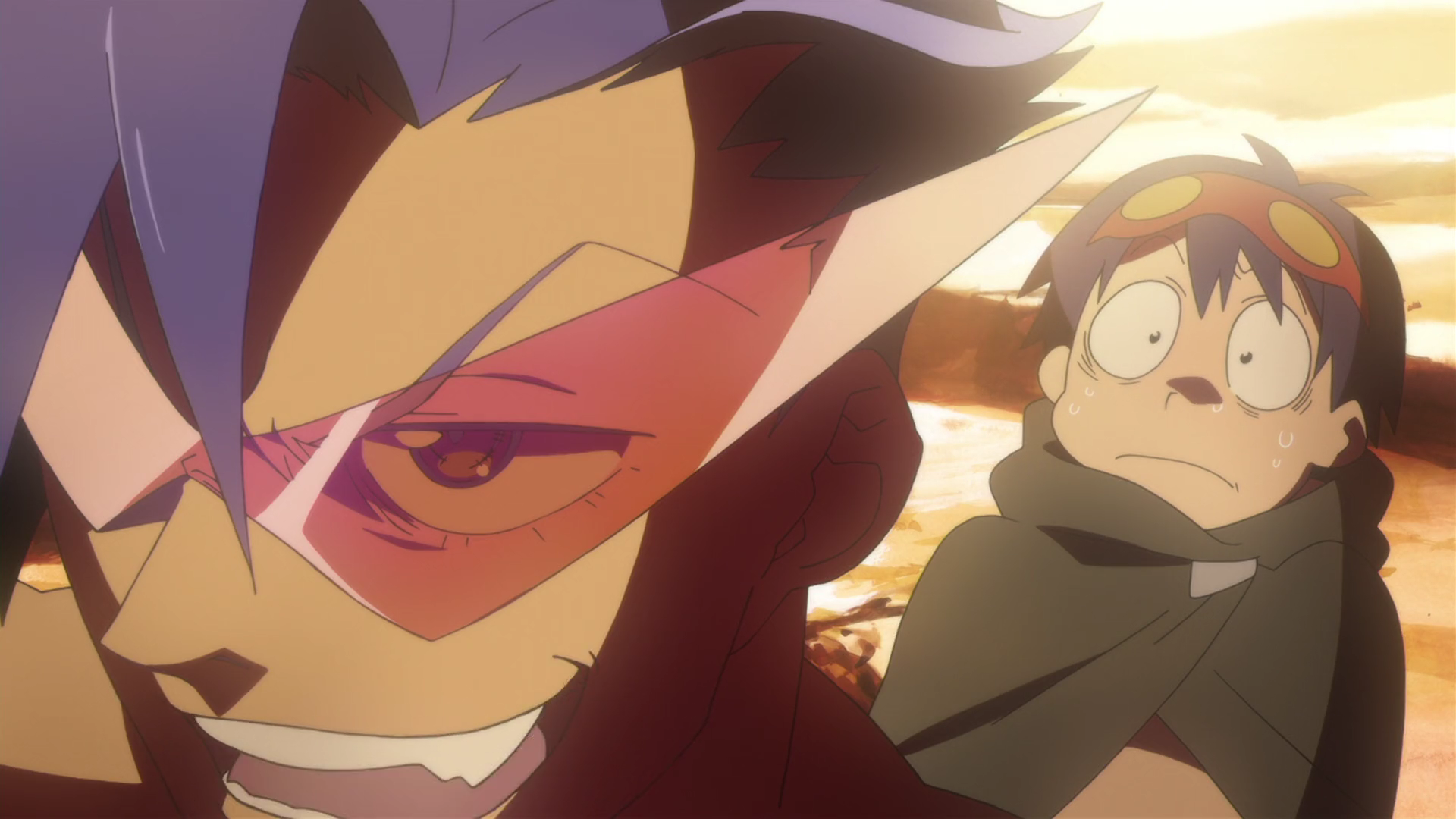
Q: For Tengen Toppa Gurren Lagann (2007), you mentioned in previous interviews that you suggested the concept of spirals be linked to evolution. Were there other themes you tried to address in the series’ script? Which ones?
A: The story is about the growth of a young man. I took into account that a person dedicated to revolution and a person dedicated to government must be different, so I gave great importance to the transition between those two moments. Simon is the one who dug the hole for the tunnel, and the following generations who paved it.
Q: In Gurren Lagann, you also pay homage to the Getter Robo franchise, which is also from the mecha genre. Why do you think the mecha genre has maintained its popularity from its inception to the present day?
A: The romanticism toward these gigantic figures that take human form is something very important. I grew up watching Mazinger Z and Getter Robo, so in my work, I want to transmit that emotion I had as a child.
Q: For the anime Kill la Kill (2013-2014), you worked again with director Imaishi Hiroyuki. The plot mixes funny and exaggerated moments with impactful scenes and a serious background. Could you share what the process was like to define the tone of the anime? Do you consider the anime to follow a similar tone to Gurren Lagann?
A: It does share common points with Gurren Lagann because both Imaishi-san and I like these types of works. Yes, a very serious scene can be followed by comedy to create a contrast that we love.
Q: In addition to anime series, you also participated as a screenwriter for the movie Promare (2019). Do you believe there is space to expand the future of the characters and the civilization? Or is it preferable to leave this aspect to the viewer’s interpretation?
A: At the moment, we are not considering the possibility of creating anything additional. I would like the fans, using their own imagination, to think about what might have happened afterward.
Q: Subsequently, you participated in the anime Brand New Animal (2020). Was it complicated to move away from mecha and combat-driven stories to approach a more “urban” plot?
A: I always seek to depict the world where the protagonists live. It was the same with Gurren Lagann, Promare, and Kill la Kill. However, the difference is that, in the case of Brand New Animal, we worked alongside the production company on the theme of women’s empowerment. I also took into account that there should be an internal struggle regarding the specific characteristics of the animal.
What would happen if there were an animal world within the human world? That is what Anima City signifies. Creating that world was very fun. However, I only had 12 episodes, so I couldn’t finish depicting the entire world I wanted. In that sense, I had to rush which was a bit sad for me.
Q: The anime you have worked on, while containing abundant fantastic elements, have allowed viewers worldwide to empathize with the characters’ stories. How can this combination be achieved through the script? Do you have any advice for aspiring writers?
A: Perhaps the characters’ way of acting is “radical,” but the important thing is that it is understandable and interesting. Empathy in my works means being able to share something radical that is pleasant at the same time.
It is not about a theory inside your head; rather, it is about actions that showcase that “radical principle.” That is perhaps what is triggering the empathy you mentioned from the audience.
I come from the world of theater. That is a performance carried out by real actors. To achieve it, the actors must be convinced. To ask them for something eccentric, you have to explain how and why you are doing it. Starting from this experience, I try to reflect the same in anime.
Q: A recurring aspect in several of your works is that characters who begin as antagonists end up becoming allies of the protagonists. Do you consider this to be a personal hallmark of your writing?
A: In my childhood, I also watched works in which these types of scenes appeared, and I found it interesting. But what I think is that antagonists must also have their own criteria, their own virtue. Perhaps those different beliefs clash at the beginning, but then at some point in the story, they understand each other. That is what turns an antagonist into an ally. But generally speaking, I do it because I like it.
Q: Both narratively and in the music or designs, many of the projects you have been involved in contain Western elements. Could you tell us if you have any Western references in terms of writing?
A: There are many, because I like Hollywood action cinema. My favorite movie is Indiana Jones and the Raiders of the Lost Ark. Also The Great Escape with Steve McQueen, and the films of Steven Spielberg.
Q: Regarding your recent participation in Batman Ninja vs. Yakuza League (2025), how did it feel to work on a story about a superhero with such a worldwide legacy as Batman?
A: The world is crazy in this movie, and I focused on how to fit a famous character like Batman into that crazy world. The setting may seem strange, but it maintains the essence of Batman.
Q: Finally, could you provide a message to the fans of your work around the world?
A: I have worked on various anime projects, and if you found my work interesting, then I would like to invite you to see my stage plays as well. They represent some of the characteristics found in anime and action cinema.
We want to extend our thanks to Nakashima-sensei for taking the time for this interview. Invited by the author, we also participated in a Tengosei: Shaman Star screening and panel hosted by him, which we’ll review in an upcoming article.
Don’t miss the chance to be part of the next edition of Salon del Manga the upcoming December 5-8 at the Fira Barcelona Gran Via convention center (Barcelona, Spain).
© GAINAX, KAZUKI NAKASHIMA / Aniplex, KDE-J, TV TOKYO, DENTSU

Join the discussion
Comments are linked to your Anime Corner account and published after moderation.
Sign in to comment
Use your Anime Corner Portal account across all Anime Corner services.