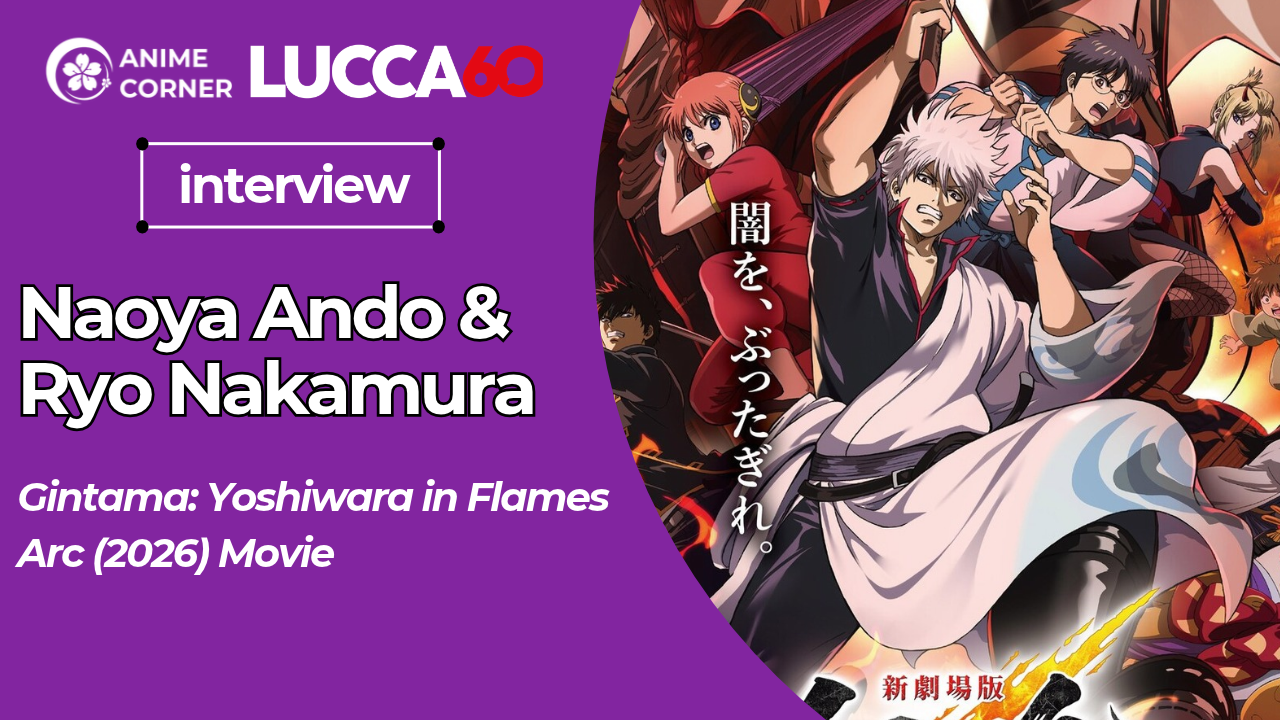
During their visit to Lucca Comics & Games promoting the anime film Gintama: Yoshiwara in Flames Arc, we sat down with director Naoya Ando and producer Ryo Nakamura to talk about their approach to this new adaptation of the Yoshiwara storyline, which is officially streaming on Netflix worldwide.
The Yoshiwara in Flames Arc was originally adapted into anime in 2009 and introduces the underground district of Yoshiwara, a place governed by different laws in the Gintama world. The arc also marks the debut of recurring characters in the series such as Tsukuyo, Kamui, Abuto, Seita, and Hinowa. While both the original manga and anime series have already concluded, old and new fans can now enjoy the Yoshiwara in Flames Arc in cinemascope.

Portions of this interview had been edited for clarity. This interview was conducted with the assistance of an interpreter.
Q: If you could choose to be part of any group in Gintama, like the Shinsengumi or the Yorozuya, which one would you choose and why?
Ando-san: The Yorozuya, because they are very free.
Nakamura-san: The Shinsengumi. I’m a fan of Hijikata. They are historically important in Japan, too.
Q: Do you also like mayonnaise?
Nakamura-san: Yes [laughs].
Q: The Yoshiwara in Flames Arc is an important and memorable arc in the Gintama series. How was it decided to make a film adaptation?
Ando-san: The producers decided to make a new animated film because this arc of the series was very popular—especially since there are so many characters and it’s very dynamic. It’s been 17 years since the original arc aired. Technology has advanced, and I’ve grown up too, so I wanted to put my skills to the test. That’s why I was happy to be chosen for this role.
Q: This arc also develops the characters of Tsukuyo and Kagura. How did you approach adapting both characters for the movie?
Ando-san: Tsukuyo is a great girl. Since she’s very charming and popular, I tried to portray her in a way that would appeal even to those seeing her for the first time, which is why I made her a bit cuter. Regarding Kagura, there’s a very important scene where she meets her older brother, and that’s when her past is revealed. She seems a little ditzy, but behind that facade, there’s something—there’s a past.
Q: What was the hardest part of planning this new adaptation, considering how long the original arc was in the anime?
Ando-san: The difficult part was that the whole movie was supposed to be two hours long, but in the end, it was two hours and 40 minutes, so we had to make some choices. I was asked to add more characters, and as we added them, we had to cut other scenes out.
Q: Was there any scene that got left out that you would have loved to include?
Ando-san: The fight between Umibozu and Hosen, when Umibozu had to go to the bathroom [laughs].
Q: What are the core themes of the movie that you tried to convey?
Ando-san: What matters is the bond—whether it’s family or friendship. For example, when Gintoki faces enemies, “a single candle is dim, but with many candles, the light grows bright.” Together, friends can defeat enemies with a brighter light.
Q: Gintama is known for blending comedy and parodies with deeply emotional moments, especially in this arc. How did you balance the humor and serious tone in this adaptation?
Ando-san: I tried not to cut any of the humorous scenes because, even though we were limited by time, the best thing about Gintama is its slightly silly humor.
Q: What do you think is the secret behind Gintama‘s lasting appeal after all these years?
Ando-san: First of all, the characters are very interesting and compelling—especially Gintoki. Even when Gintok doesn’t act or speak, his whole demeanor says a lot; he’s fascinating. At first, he makes you laugh with his slightly silly sense of humor, but the next moment he can move you to tears.
Q: Overall, what should fans expect from Gintama the Movie 2026: Yoshiwara in Flames?
Ando-san: In this film, we sought to create dynamic visuals and camerawork. We didn’t have as much of that in the previous Gintama anime. Before, there was mostly humor, but since other Shonen Jump stories had the appeal of dynamic action, we wanted to incorporate that as well.
We want to extend our thanks to Ando-san, Nakamura-san, publisher Dynit, and Lucca Comics & Games for the opportunity to talk about this latest work in the Gintama series and its appeal. We got to witness firsthand the passon they share for the franchise.
About Lucca Comics & Games
Lucca Comics & Games is one of the biggest conventions in the world, taking place over five days in the historical center of the medieval Italian city of Lucca. The convention features a wide range of industries, including movies, series, video games, tabletop games, comics, anime, manga, cosplay, with their respective international guests.
The city itself is transformed for the festival, so every genre and company has a dedicated premise and whole blocks are transformed into comic hubs, tabletop zones, video game booths, and more.
Source: Netflix Official YouTube
© Sorachi Hideaki/Gintama the Movie Production Committee

Join the discussion
Comments are linked to your Anime Corner account and published after moderation.
Sign in to comment
Use your Anime Corner Portal account across all Anime Corner services.