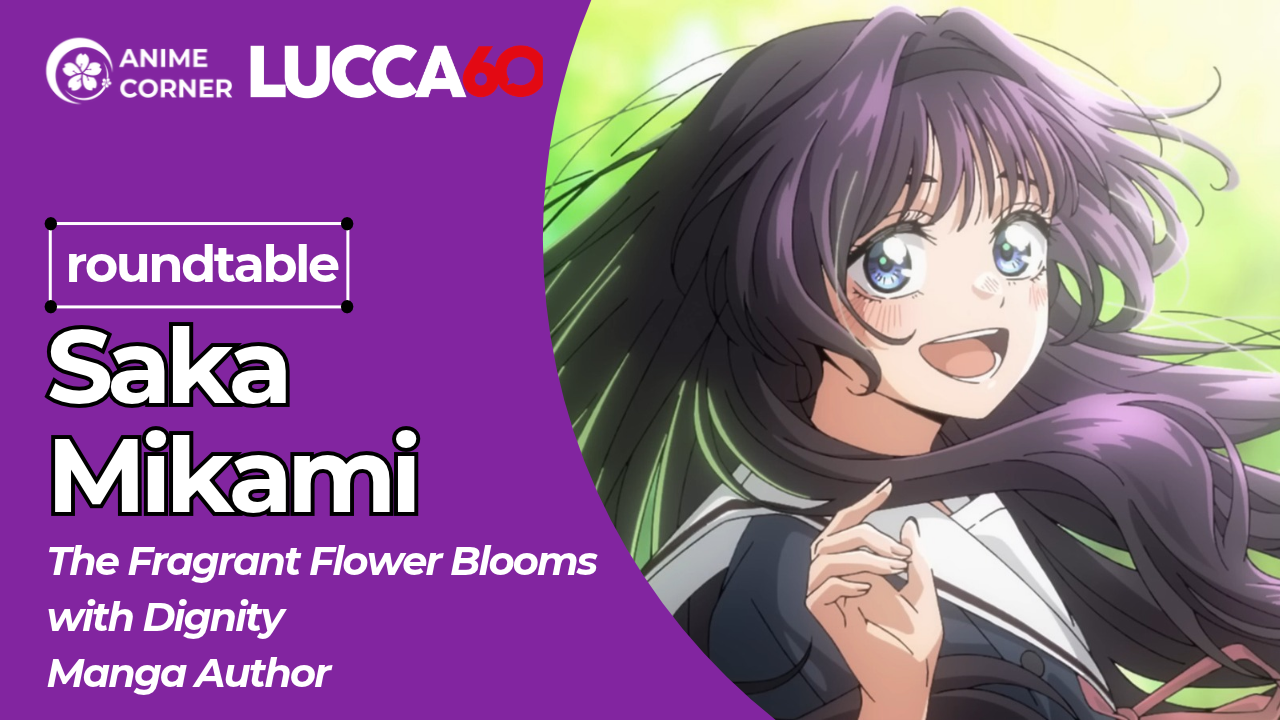
At Lucca Comics & Games 2026, Anime Corner had the opportunity to join a press café with mangaka Saka Mikami, the creator of The Fragrant Flower Blooms with Dignity (Kaoru Hana wa Rin to Saku). Serialized on Kodansha’s Magazine Pocket since 2021, the series follows Rintaro Tsumugi, a soft-hearted boy from the rough-reputed Chidori High, and Kaoruko Waguri, a student at the prestigious Kikyo Girls’ Academy next door — two schools divided by a wall and years of mutual prejudice.
With a CloverWorks anime adaptation that turned the manga into a global phenomenon, Mikami-sensei sat down with journalists from several outlets to talk about kindness, empathy, her own school days, and why a cake shop was the only possible home for her protagonist.
Portions of this interview have been edited for clarity. This interview was conducted with the assistance of an interpreter.
Q: You’ve said that Attack on Titan made you consider a career as a mangaka, while shojo manga shaped your childhood. How do these two very different influences coexist in the way you tell stories today?
Saka Mikami: From shojo manga I learned, above all, how to depict emotions — how to draw feelings without explaining them. From shonen, on the other hand, I took the structure and the drive of a story, the way a narrative is pushed forward.
Q: The two schools Rintaro and Kaoruko belong to read like a metaphor for the prejudices society builds about people. What answer do your characters give to that problem — and can that answer change an entire system?
Saka Mikami: There’s no simple answer to that. I don’t think I can offer a clear, definitive solution. What matters to me is that every reader finds in the story what they themselves believe in — whatever it is they want to see in a story.
Q: Your characters are remarkably kind to one another. Did you ever think their kindness could become a role model for young readers?
Saka Mikami: I never intended them as role models. But I draw them wishing I could be like them myself. And when readers write to me saying they’d like to be like my characters too, that makes me very happy — because I share that wish.

Q: At first glance, your manga is a typical school comedy about teenagers’ everyday lives, a theme that has been told many times. What, in your view, is the strength that has won the series such a broad, international audience?
Saka Mikami: I wouldn’t presume to call it a strength. But I care deeply about drawing not only romantic love, but also friendship and love within the family. I believe those relationships are what create empathy in readers — and that’s what I value most.
Q: In romance and shonen manga, the male lead is usually unapproachable — he keeps everyone at a distance and makes coldness his strength. Rintaro is the opposite: he looks intimidating, but he’s gentle, he talks, he opens up. Were you deliberately building an alternative to the toxic masculinity of the classic protagonist — and was that a risk?
Saka Mikami: I do understand what makes the unapproachable type attractive, the one who keeps everyone at arm’s length. But I came to the conclusion that a character like that couldn’t generate the empathy I care about. I asked myself: What kind of person can make readers feel for him? Rintaro became who he is now out of that question. The classic model simply wouldn’t have worked for that.
Q: Rintaro’s mother is a favorite for many readers. How did she come about, and how did she evolve?
Saka Mikami: At first there was no clearly nameable reason for her. Thinking about it now, it was probably my own mother. As a child, I thought of her as very strong and reliable — that never changed. But as I grew older and could talk with her as an equal, I understood that she, too, has her worries and insecurities. That realization found its way into the character.
Q: A central theme is how belonging to a group shapes the way we judge others. How much of that comes from observing contemporary Japanese society, and how much is a universal phenomenon?
Saka Mikami: The larger part is universal. It mostly comes from my own school days. There were people who, at first glance, looked like a rough, unpolished crowd. But the moment you talked to them, they were incredibly friendly and warm. You only understand people once you speak with them. That experience inspired me.

Q: Your earlier works also show a desire to tell stories about different people learning to understand one another. Does that sensibility come from something you experienced yourself, or from something you always wished to see?
Saka Mikami: From experience. When I was young, I saw arguments and conflicts between friends and thought: If only they’d just talked to each other. And I thought the same about myself — that I should have spoken to people more. Out of that came the wish to show that kind of communication in a story — and to wish it for the world.
Q: Rintaro’s family patisserie and the sweets are not just a backdrop; they become a language through which the characters express affection and care. How did the idea of putting food at the center of these relationships come about — and what’s the challenge of making those moments feel delicious and emotional in black and white?
Saka Mikami: Cakes and flowers are small things — but they’re things you can find in everyday life, and they mean a small happiness. I wanted that small happiness to spread into the world. As for the drawings, I have to be honest: the sweets are drawn by my assistants, and every time I’m amazed myself at how beautiful they turn out. But what I truly care about are the characters — the relationships that become visible through those sweets.
Q: How much of you and your own story is in the work? Do the dreams and ambitions of the characters reflect your own path as an author?
Saka Mikami: I think quite a bit. I’ve had the dream of becoming an author since I was a child, and I was lucky enough to realize it here. But I wasn’t the only one with dreams — my friends had their own. That’s why it’s so important to me to tell each character’s own story and their own dream.
Q: The relationship between your protagonists isn’t an island — it helps them grow, including through friendships and encounters with others. Do we get to know ourselves better by facing people who are different from us?
Saka Mikami: Yes. In the end, you can’t live alone. You need other people — and that’s exactly why it matters so much.
Q: Was there a scene that came to you naturally while writing or drawing — or one that took a long time to become what you wanted?
Saka Mikami: Chapter 2. That’s where Kaoruko says that line: “It’s you — I want to get to know you.” When I drew it, I thought: Wow, she can really say something like that. But the storyboard for that chapter in particular was difficult, and it took a while before it found the right shape.
Q: You once said you wanted to draw a story in which all the main characters are kind. But kindness has many faces. What is kindness to you — and which kind of kindness is the hardest to convey naturally through a character?
Saka Mikami: To me, kindness is the attitude of truly wanting to understand the other person’s feelings and situation. But if you have no room inside yourself, you become self-absorbed and can no longer be kind to others. So kindness toward others is important — but kindness toward yourself is just as important.
Q: How do you work with your editor? Do suggestions from their side change the story?
Saka Mikami: For every chapter, we first go over the rough flow before I start the actual work. Because that’s shared, there are no big changes afterward. Small adjustments and fine-tuning, though, happen all the time.
Q: The manga revolves around teenagers, but it also touches on more adult themes like work and the future. Do you want to explore those further and follow the characters’ professional paths — will we see them as adults?
Saka Mikami: It’s a school story, so it’s meant to end with high school graduation. I do have ideas of what the two of them might be like a little older, but I don’t plan to draw them as adults over a long stretch. Instead, I’m drawing their present as carefully as I can — so that they face themselves honestly now and, as adults, will have chosen a path they regret as little as possible.
Q: In love stories, the confession is usually the goal everything builds toward. Your protagonists confessed their feelings long ago. Where is the endpoint for the two of them, as far as you’re concerned?
Saka Mikami: I believe I can tell their relationship up to graduation. And honestly, the time after getting together is much longer than the time before. That’s exactly the journey I wanted to tell at a calm pace how the two of them are still unsure even after the confession and feel their way toward each other. That’s why I wanted to bring them together early.
Q: Sweets are an essential element of your manga. Where did the idea come from that Rintaro’s family, of all things, runs a cake shop?
Saka Mikami: That overlaps with what I said earlier: I wished for everyday life to contain something so lovely that you’d want to eat cake every single day. And I chose the patisserie because I wanted precisely that contrast between Rintaro’s slightly intimidating appearance and the cakes.
We want to extend our thanks to Saka Mikami and Lucca Comics & Games for the opportunity to be part in this exclusive roundtable.

About Lucca Comics & Games
Lucca Comics & Games is one of the biggest conventions in the world, taking place over five days in the historical center of the medieval Italian city of Lucca. The convention features a wide range of industries, including movies, series, video games, tabletop games, comics, anime, manga, cosplay, with their respective international guests. The city itself is transformed for the festival, so every genre and company has a dedicated premise and whole blocks are transformed into comic hubs, tabletop zones, video game booths, and more.
Picture Copyright: © Saka Mikami / Kodansha / The Fragrant Flower Blooms With Dignity Production Committee

Join the discussion
Comments are linked to your Anime Corner account and published after moderation.
Sign in to comment
Use your Anime Corner Portal account across all Anime Corner services.