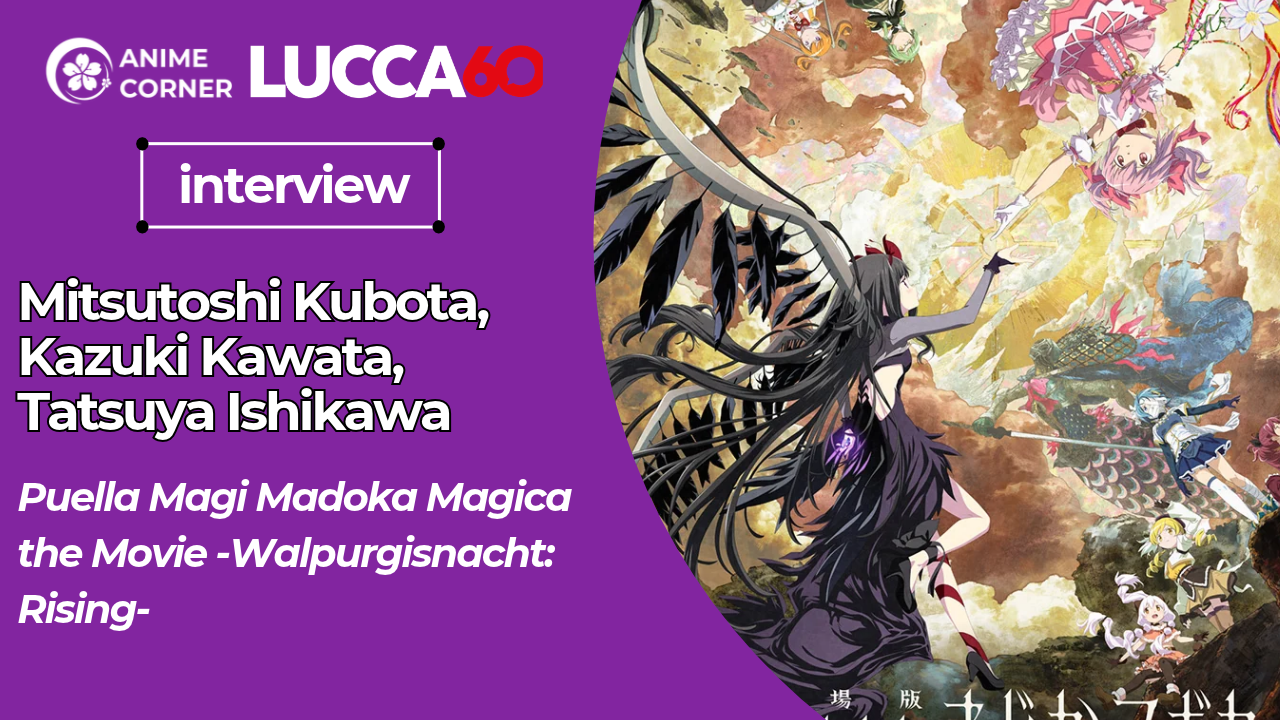
The long-awaited movie Puella Magi Madoka Magica the Movie -Walpurgisnacht: Rising- made its Italian debut at Lucca Comics & Games on October 28. Thanks to publisher Dynit, Studio SHAFT’s CEO Mitsutoshi Kubota, animator and visual concept designer Kazuki Kawata, and Aniplex producer Tatsuya Ishikawa presented Walpurgisnacht: Rising, took part in a press conference, and sat down in an exclusive interview with us.
Walpurgisnacht: Rising releases 13 years after Puella Magi Madoka Magica the Movie: Rebellion, the last installment of the series. Building on that expectation, we talked with the three guests about the production process and the impact of the franchise.

Portions of this interview have been edited for length and clarity. This interview was conducted with the assistance of an interpreter. Beware of Puella Magi Madoka Magica the Movie -Walpurgisnacht: Rising- plot spoilers below.
Q: What was the moment you realized, ‘This is it! We are ready to release Walpurgisnacht Rising‘?
Kubota-san: Because animation is created step-by-step in a specific order — first the script comes together, then the image boards and storyboards are finished, setting the stage and atmosphere — everything gradually establishes itself toward completion until, at the very end, it reaches 100%. That’s how we make it. Even after it’s put together on film, we go through ‘retakes’ over and over again, and as the precision keeps rising piece by piece, that’s the moment you feel, ‘Ah, we can actually pull this off.’
Once what we’re creating reaches that high level of completion, it comes down to the person who makes the final call to decide “Okay, no more retakes.” To put it another way, there is a deadline for completion, so we work toward that ‘up to here’ finish line that we’ve set, making adjustments along the way to finish the film.
Ishikawa-san: Of course, there is strictly a set deadline — and that deadline is supposed to be absolute. However, when we are doing retakes and we are certain that doing one more retake will make the film even better, the deadline often ends up getting pushed back a little bit. That definitely happens [laughs].
Q: Why do you think Madoka Magica left such a strong impact on the anime community?
Ishikawa-san: Madoka Magica aired on television in Japan back in 2011. Following that, there was a whole boom in the Japanese anime industry of creating original anime that lasted for quite a while. Regarding how to create original anime, Madoka Magica had a lot of influence. Before Madoka Magica, original anime were often commissioned or driven primarily by individual studios or directors in a traditional format. After Madoka Magica, there was a shift toward building a cohesive team from the very beginning—bringing together the anime studio, character designer, and screenwriter as a unified creative unit. Which goes to the creativity of one team of talented people.
Q: What are the core themes and emotions you tried to convey in this movie?
Kawata-san: Since my work was the details of the film, it’s difficult to discuss the core themes. In this movie, we had to draw the birth of the Walpurgisnacht’s night, which I think is the core of the story. But many fans have talked about other themes in the film too. What the core theme is can vary from person to person.
Kubota-san: I consider that the most important part of the story is that magic can make hopes and dreams come true in the real world. The Madoka Magica series started with the dreams of adolescent girls. Each girl has family, friends, and different things they consider important. They make decisions on their own based on those hopes. For example, Sayaka has a dream like a normal girl, she hopes for the recovery of her friend.
Q: Do you have a particular favorite scene?
Kawata-san: My favorite scene is when Marguerite’s soul gem absorbs the impurity from all the girls and reaches its limit, looking like a dead body.
Kubota-san: For me, the initial scene is the most impressive of the film. The scene features the battle between a magical beast and “Girl A.” It features marvelous art since a lot of talented animators worked on it, including Gekidan Inu Curry [a duo of animators known for their work in the Madoka Magica titles]. This initial battle is the highest point of the movie, and it even features the song “Kanata” by composer Yuki Kajiura.
Ishikawa-san: My favorite part is the hard conversation between Nagisa and Sayaka.
Q: What lessons or messages can we take away from Madoka Magica that apply to real life?
Kubota-san: Chiwa Saito, who portrays Homura, said that the promise is very important because there’s a contract involved. The idea of a promise and its importance is the common ground between the Madoka Magica series and the real world.
We want to extend our thanks to Studio SHAFT, Aniplex, and Lucca Comics & Games for the opportunity to watch the movie at the festival and to take a deep dive into the creation process of the film.
If you are a fan of SHAFT’s works, we also talked with Kubota-san about the upcoming adaptation of Just Like Mona Lisa, along with the manga author and the Cyberagent producer.
About Lucca Comics & Games
Lucca Comics & Games is one of the biggest conventions in the world, taking place over five days in the historical center of the medieval Italian city of Lucca. The convention features a wide range of industries, including movies, series, video games, tabletop games, comics, anime, manga, cosplay, with their respective international guests.
The city itself is transformed for the festival, so every genre and company has a dedicated premise and whole blocks are transformed into comic hubs, tabletop zones, video game booths, and more.

Join the discussion
Comments are linked to your Anime Corner account and published after moderation.
Sign in to comment
Use your Anime Corner Portal account across all Anime Corner services.