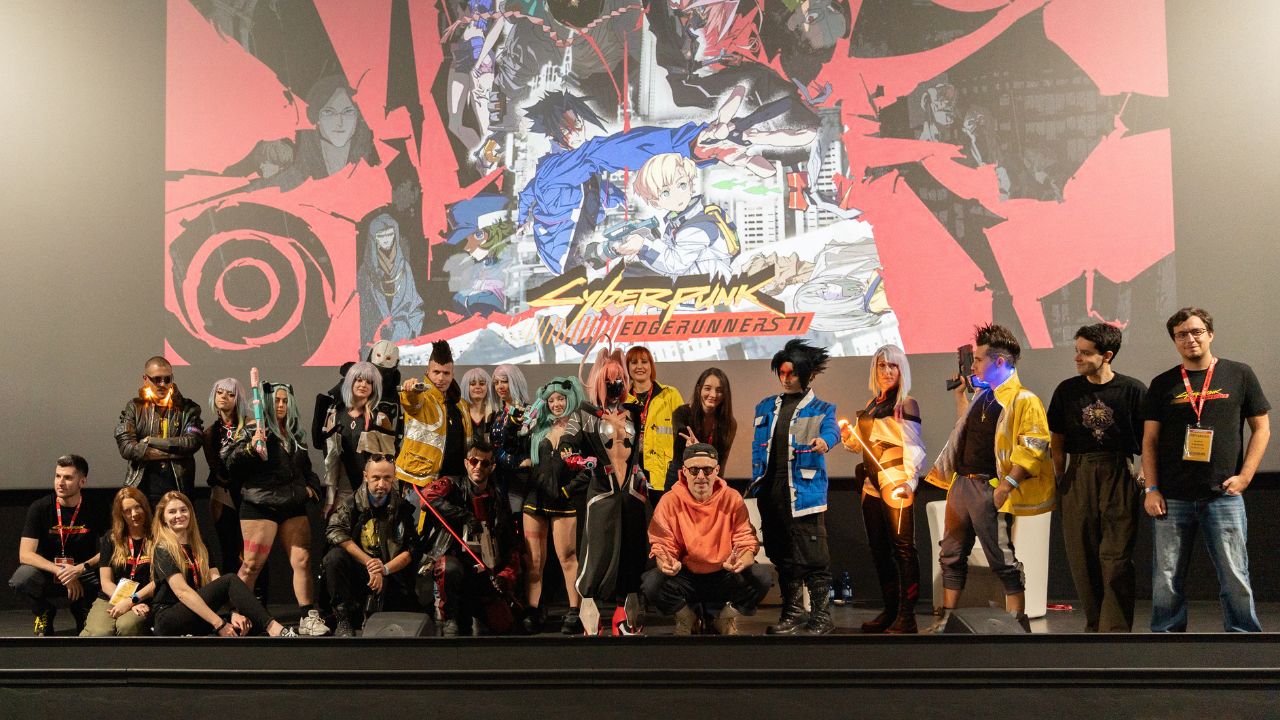
CYBERPUNK: EDGERUNNERS 2 left no one indifferent after the worldwide release of the ten-episode season on October 20. The latest installment is a new story in the noir world of Night City after the events of Season 1, with a whole new set of characters and ideas on the table brought to life again by Studio TRIGGER and CD PROJEKT RED (CDPR).
Following the premiere, Season 2’s showrunner Bartosz Sztybor and executive producer Saya Elder from CDPR flew to the Italian festival Lucca Comics & Games and took part in a special panel on the third day of the convention, October 30, in Cinema Astra. Under the name “Emotional Damage: How Cyberpunk: Edgerunners 2 Makes You Feel,” both guests spoke with journalist Eva Carducci about the decisions behind the new season, and the emotions they put into the show.

Portions of this panel have been edited for clarity. Beware of CYBERPUNK: EDGERUNNERS 1 and 2 plot spoilers below.
Q: How do you make people emotional?
Bartosz: Honestly I don’t know. It just happens. What needs to be done is that the creators need to be sincere with themselves. That’s why I always put myself into the characters that I’m creating. It’s also important that when I write stories, they are always character driven. The plot is important, of course. But the character is the most important thing in the plot.
Sometimes people ask me about the endings. Yes, when I start writing there is an ending, but sometimes while you are writing the character, you start understanding the character a bit more. Suddenly the character can do something that surprises you, because you get to know the character, and they start living their own lives. That’s the way to make characters that are close to your heart and that are real.
And then you just have to put them through a lot of shit [laughs].
It’s like one of my favorite writer’s rules on how to write a perfect story. Rule number 5: be a sadist. Create characters, create them as likeable characters, and put them through the biggest shit possible.
Saya: I also think that creating a story that makes people emotional is a group effort. I feel that way myself, as do a lot of people in the audience, who grew up reading a lot of amazing fiction and stories that are specifically targeted to make people feel things strongly.
When I was reading the first script, it didn’t make me cry. But when the whole production started—when the animation came together, when the character designs from Studio TRIGGER came in, when we went through every single voice recording session, every single dubbing session—everything came together in episode 10. That’s the first time I did cry.
It finally made clear what our amazing artists’ vision was; it all came together. Having the music, having the voice recording, having the colors: everything came together at the end to make a product that has a lot of love and passion behind it. We were able to create something that I feel the audience can understand, including what the vision was, because we all created it together.
Bartosz: A very good example of that is a scene that I originally hated on paper from Season 1. There is a scene between Maine and Dorio where they start fighting and then they end up kissing. On paper I felt “the hell?” I think this scene was suggested by Otsuka-san or Usa-san.
Then I saw the director’s vision. When I saw the final scene animated, for me it’s one of the most important scenes to understand Maine’s relationship with Dorio, that they really were in love, and that’s why episode 6 hits even more. Building on what Saya said, that sometimes things on paper don’t work, we were blessed with amazing directors and an amazing studio that put “not-so-interesting ideas” into cinema magic.
Q: Hearing that you cried makes us feel less alone as viewers because we connected so deeply with those characters. What was it like developing new characters for Season 2? How did you create something emotional yet distinct from Season 1?
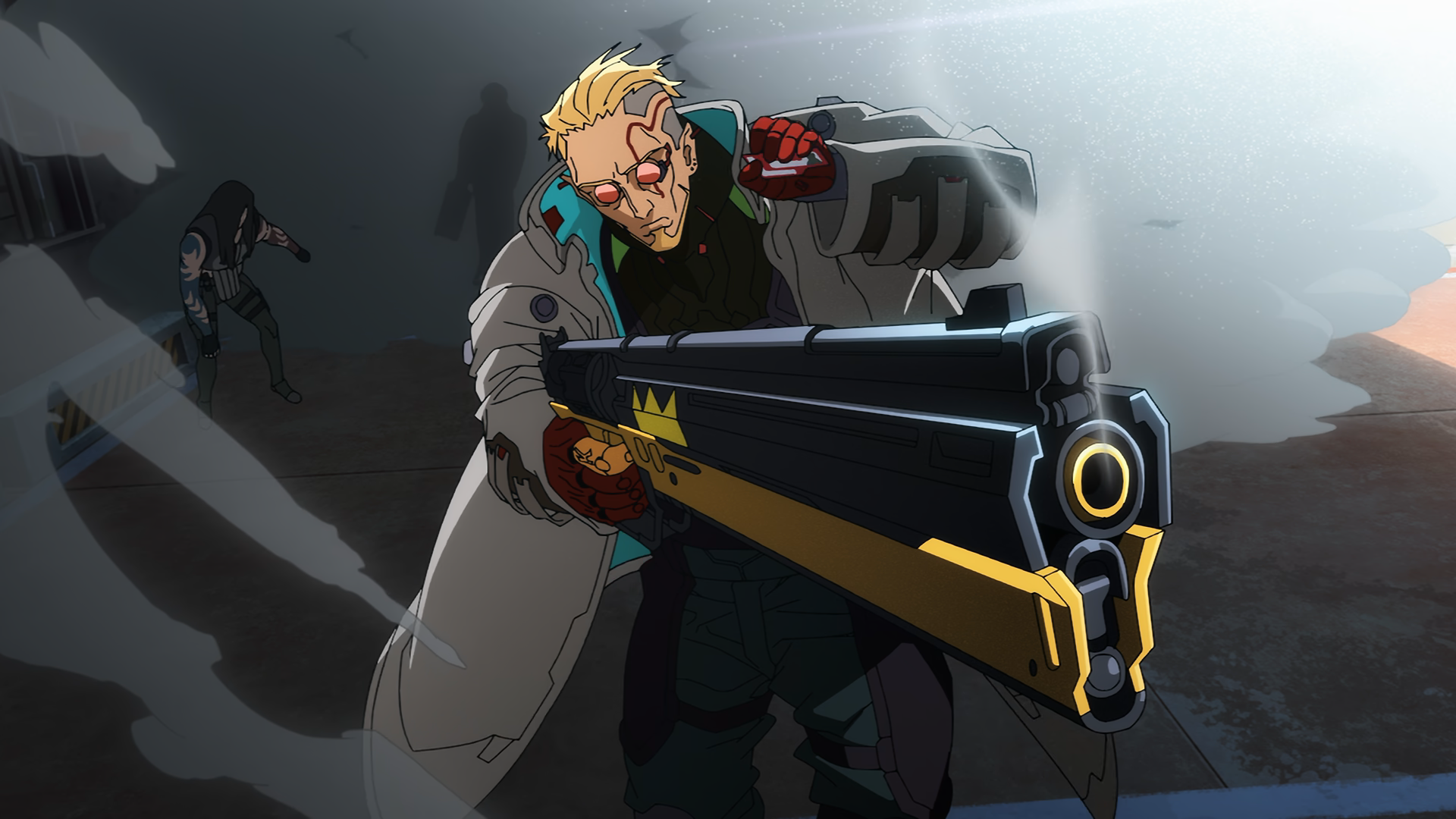
Bartosz: It started with Weak. I had an original idea while working on Season 1 to do EDGERUNNERS but in reverse, “zero to hero and hero to zero,” and that’s how Weak started existing. Then I prepared the pitch with a couple of characters, because the main inspiration for Season 2 was Pulp Fiction, not only one character, but a few of them. After that it was pure effort.
I know that in the first pitch there was Weak and Talia, but D was suggested by Ikarashi-san, and Roman was something that came from my discussion with Ikarashi-san and Otsuka-san about our love for cinema. The core idea was Weak and Talia in this dad and daughter relationship and the old cyberpunk to be closer to Season 1. But then we were wondering what kind of characters would be the best for this story, and the themes in them. Would we be changing characters? It was one year and a half of back and forth with Studio TRIGGER creating those characters. Who should they be to make this story matter [clapping]. I’m just getting this after every answer. I feel like I’m saying something intelligent, but I don’t think so [laughs].
Saya: I don’t think it’s any secret that when we were creating EDGERUNNERS 1, we had no intention of creating EDGERUNNERS 2. It was going to be a one-off show. That’s why we were able to put everything into it. Studio TRIGGER also said, in several interviews, that they put all of what they had into EDGERUNNERS 1 and that’s why we think it became a show that was so special and it resonated with a lot of the audiences. I wouldn’t say there was no pressure—I’m sure Bartosz felt a lot of it going into Season 2.
Bartosz: It’s funny, when there’s a question about pressure, I’m like “no, no pressure.” But internally I’m like, “I was shitting my pants every day.” [laughs]
Saya: For EDGERUNNERS 2, we agreed that we would make it if Bartosz was able to come up with a really good pitch and a really good new cast of characters. The first thing he said as we walked into Studio TRIGGER was, “I want to do Pulp Fiction and Léon: The Professional in Night City,” and everyone loved that. Starting with that killer concept, I don’t want to say it’s easy, but it was easier to visualize what kind of characters we were going to give life to and what kind of general story we were going to aim for with EDGERUNNERS 2.
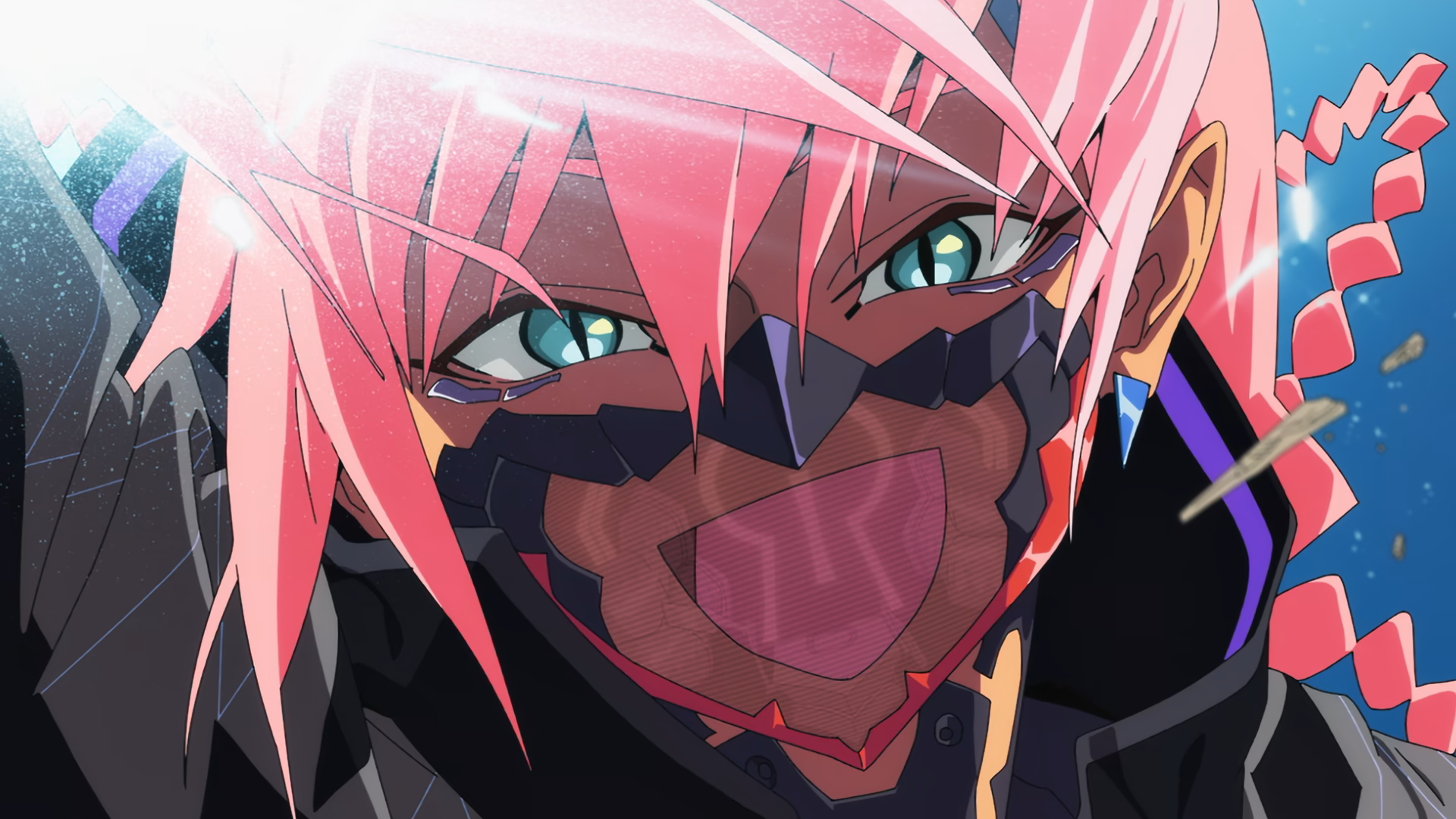
Q: I love that you like cinema. I’m a huge cinema lover like you. I think that Roman in particular, and the love for cinema resonates with all of us. Do you think that this is the power of the story? How was cinema central in all this process?
Bartosz: I grew up with movies, so Season 2 is my love letter to cinema. About the process, while we were working on Season 1, there were a lot of anime references. I was afraid that while working on Season 2, which will be a very cinema-driven season, that it would be hard for me to talk to Ikarashi-san, because maybe he was more into anime than cinema. But it was a huge surprise for me that suddenly I realized that he is a cinephile, that he is a movie buff, that he knows a lot of European cinema from the 60s or 70s, that he even knows Kieślowski and Wajda, our Polish cinema legends. When we were talking about the scenes, the script and all that, I was bringing some movie references and he understood everything.
Studio TRIGGER’s approach and also Ikarashi-san’s approach to the visuals is very cinematic. There is not enough praise for the visuals in Season 2. The things that Ikarashi-san did with the light, the shadows, the colours, the editing: for me, it was never done in anime. He is doing things that are reserved for live-action cinema.
I’d say cinema was really important in this process. To what you said about trauma, it moves me all the time. One of my favourite scenes in Season 2 is the one where Roman is with Talia in the drive-in theatre. It always moves me.
Saya: Actually, earlier when I was doing the little signing session, there was a young lady who came up and said that she wants to be a producer someday. Building on what Bartosz was saying, my advice for everyone who wants to get into the industry is to watch a lot of cinema and live-action theater. Of course, understanding anime history and how it became a mainstream form of media is essential. But when we went into our creative sessions with Studio TRIGGER and we talked about how we are going to shape this season, and what these characters’ arcs were going to be, they so frequently referenced old media from 80s and 90s films.
It would be helpful if you can go into those meetings with a baseline knowledge on these films so you are able to have a conversation with them and say, “Yes, I have seen the film Magnolia, I love the characters, and the main character’s arc was this—maybe we can replicate their arc into the story this way,” or “We can take the cinematography from this movie, take inspiration from that one, and do this scene or shot from this angle.” That is the kind of skill that would be really, really helpful when coming into this industry.
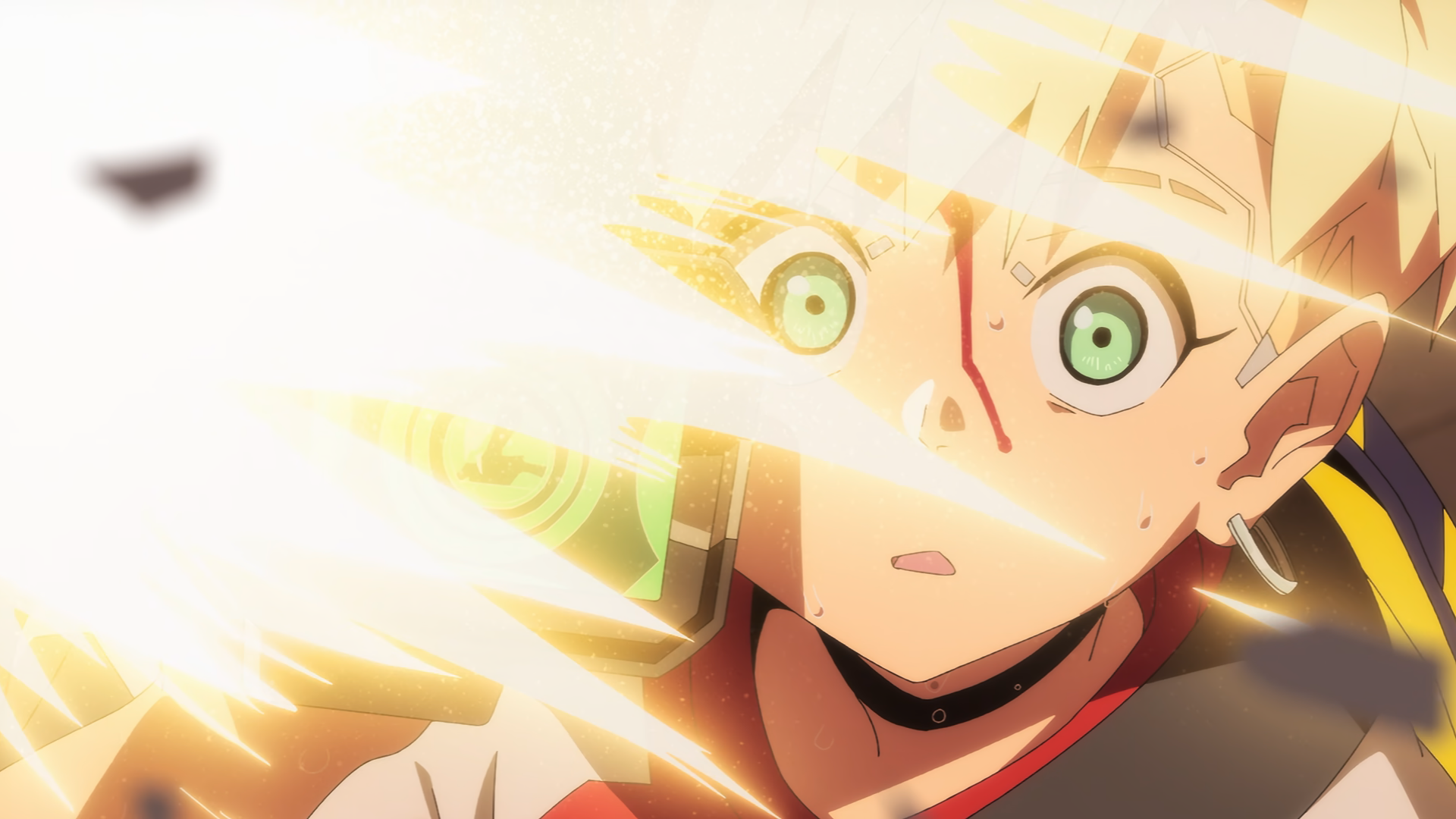
Q: You tackle a different kind of love for Season 2. The romantic love is in Season 1. Here we have different kinds, like a father-daughter relationship. How do you set the emotional track? Why do we care so much about these characters?
Bartosz: I don’t think there’s one rule to that. The first week of writing is wrong. That’s the rule. When you’re creating something, it has to be sincere. For me, in Season 1, David’s story was his relationship with his mother which was inspired by my relationship with my mother. What was funny was that it was the same for the whole Japanese team. I guess she was like an Asian-Polish mother.
We were just putting ourselves into that. Season 2, for me, is in constant dialogue with Season 1. It subverts expectations, it uses themes from Season 1, but in a different way. All the characters are created with a clear emotional goal and they are somehow flawed, and those flaws are, I would say, real and sincere. They come from the bottom of my heart, or Saya’s heart, or Ikarashi-san’s heart. I think that’s the way.
I remember that when we were working on Season 1 pilot, we were writing that for six months, with this weird Hollywood approach, like “Okay, we need to do this and that and that for the audience to feel for David.” Then there were multiple drafts of the script. But for me, when Studio TRIGGER came into the picture, when I started writing that first script with them, I thought they brought the Japanese approach to storytelling. For us, for Westerners, for Hollywood, logic is more important than emotions. What they taught me is that sometimes you shouldn’t care about logic. You should go with emotions. That’s why some of the scenes are so emotional and the characters feel so real. It also showed us how we should create storytelling.
Saya: One thing that really surprised me when EDGERUNNERS 2 was announced was that a lot of people online were saying, “Ah, they’re going to kill everyone again.” That’s actually quite unexpected for me because when writing EDGERUNNERS 1, we didn’t go into the story with the expectation that everyone was going to die. This kind of goes into what Bartosz was saying about logic.
There are certain logical rules inside the cyberpunk world. For example, if you fight Adam Smasher… no, you’re not. We have seen that. [laughs] There are a couple of rules inside the world that are unbendable. If you put in too much cyberware, you’re probably going to go a little bit psycho. What we did with Studio TRIGGER is discuss what the rules are of this universe, what kind of story we can create within that.
Even going into EDGERUNNERS 2, we didn’t have any set goals or expectations that we’re going to kill everyone, we’re going to make everyone cry by doing this really, really sad, horrible, terrible arc. It’s just a matter of having characters, putting them into this world of anxiety and seeing how they survive.
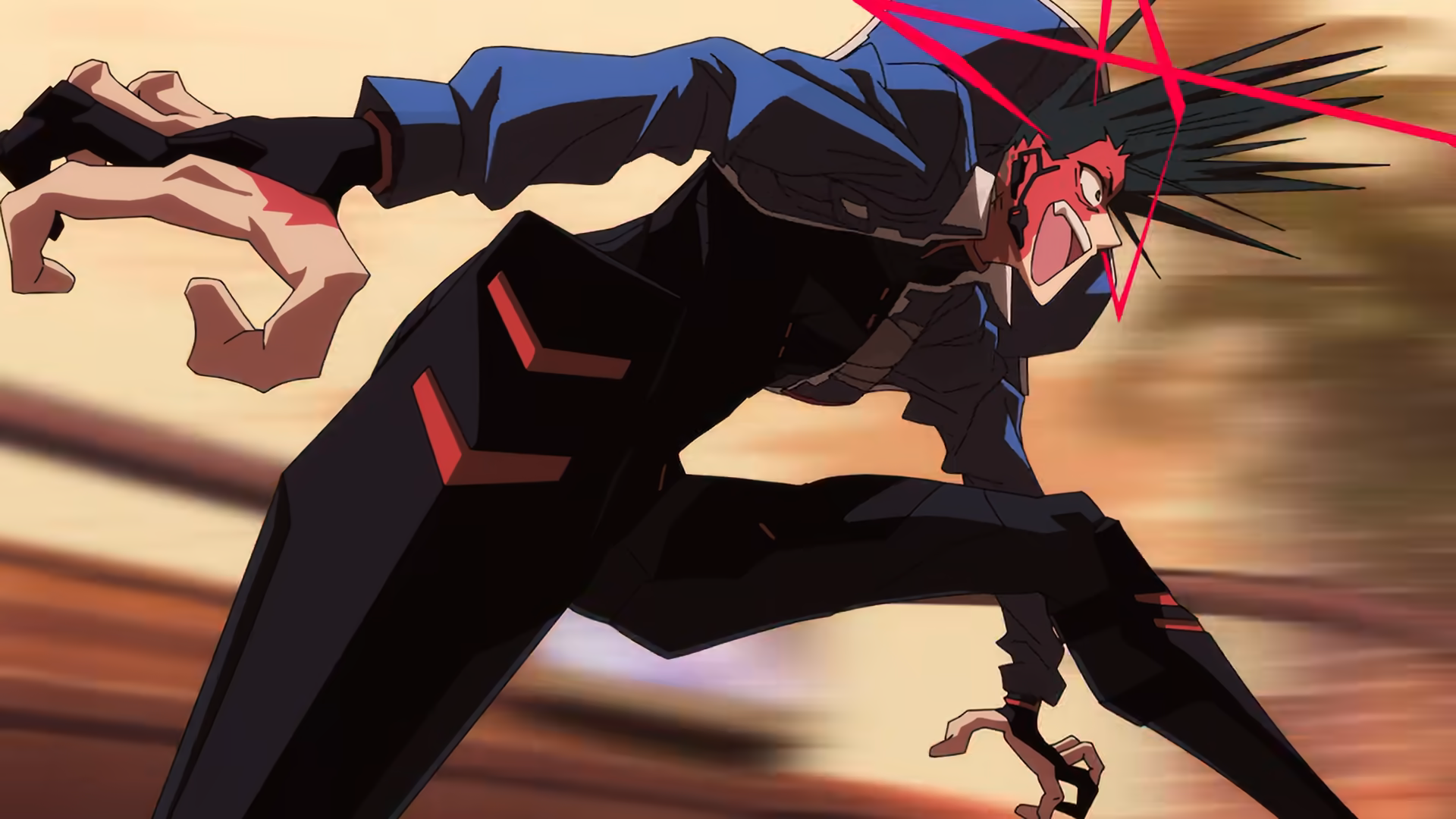
Q: Here, maybe thanks also to Disney or the movies that we usually watch, we wait for a happy ending. How important is it for you to break that catharsis? How important is it to you not to take the happy ending for granted?
Bartosz: That’s why I love both Cyberpunk 2077 and The Witcher. In CDPR we have this vibe of being sad all the time and breaking expectations. Personally, I’m tired of Hollywood movies where there’s always happy endings. With those movies, probably you all have the same feeling of “now the fight ends, we have a third act, and everyone will have a happy ending, the protagonist will manage to run to the airport and save the love of his life.”
Cyberpunk, as a noir genre, always breaks expectations. But it’s not only that. When I was doing some interviews about Season 1 and people were like, “Okay, so it’s not a happy ending.” Now there are also people talking about Season 2 and that it had a happy ending. I’m like “eeeeeh” [laughs] For me, what is important is not a happy or bad ending but an open ending. That’s why I love Christopher Nolan’s movies—maybe not the last ones [laughs]. But I like an ending that stays with you and you interpret it in your own way.
That’s why Season 2 gets dark much sooner than Season 1, around episode 4 or 5. Season 2 gets super dark compared to episode 9 of Season 1. People are so fed up with the darkness of Season 2 that they needed this “happy ending” so much. If they watch this Season 2 open ending they’re like, “yes, at last, I have this catharsis.” The same happens with Season 1 but from the other side. The tension is growing since episode six so much that you just start searching for the release. For me, the goal is to have an open ending and subverting expectations rather than a three-act construction of the story.
Saya: It’s really interesting because Studio TRIGGER is really particular about achieving catharsis at the end of each season. This was a word that was repeated several times throughout the production and I do think Japanese media tend to prefer happy endings a lot of times, and I’m not saying that all anime have happy endings, there are tons of anime that don’t have happy endings. But Studio TRIGGER’s productions try to attain a level of catharsis at the end of their shows and that’s their preference. When working between CDPR and Studio TRIGGER, there was always a conversation of “How will we be able to create a narrative that will be satisfying for the audience? How can we make David likeable so that in the end, when he does reach the end, the audience will still like him?”
There were so many iterations of EDGERUNNERS 1. We went through five separate outlines and scripts of David going through different narrative story arcs and him growing up in separate different ways. That is specifically what Studio TRIGGER was requesting from us: if we make a show together, it has to have a satisfying ending. It doesn’t necessarily need to be happy, but we absolutely needed to make sure that the audience was satisfied by the end of the show.
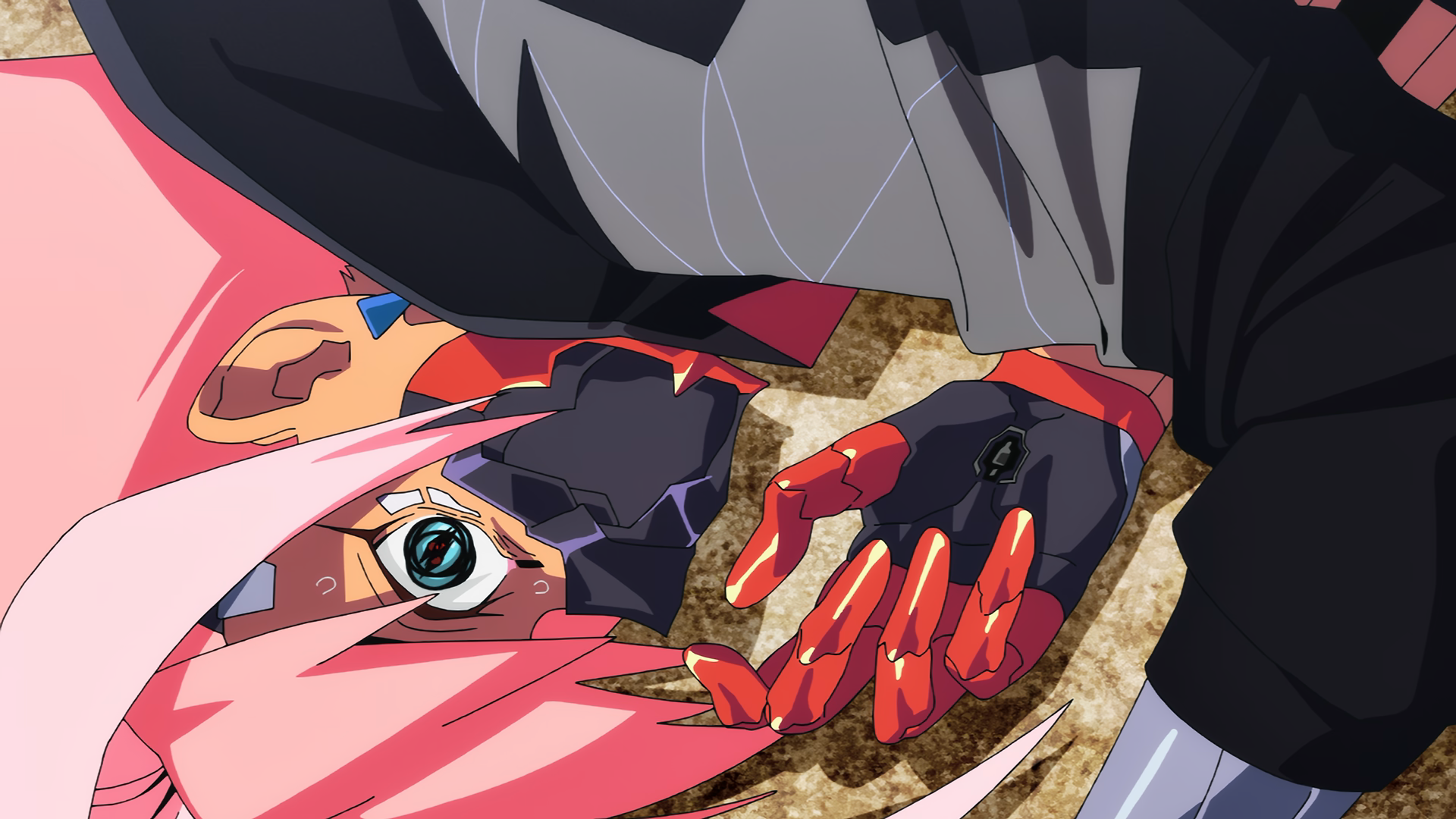
Q: You haven’t told the same story twice but there is a connection I want to talk about between EDGERUNNERS 1 and 2—and that is the fact that the characters are “wolves.” They are not the good guys. There is not this bad guy and the good guys. I’m actually interested in that aspect.
Bartosz: I would call it moral “grayness,” which is not only important for this genre. If you know The Witcher, you’ll see there is also moral grayness. You don’t have good or bad people. That’s why those two works, Cyberpunk 2077 and The Witcher, are very similar in a way. This is not Tolkien, with tall, good elves and bad Sauron. Sauron can be a good guy in CDPR because “someone fired him” [laughs]. He’s angry and you understand why. I feel like in a comic, it’s like someone stole a ring from him. Dude, that’s not nice [laughs].
It is important that the audiences see it’s real life, that people are making choices, and those people can make good choices, but it also has consequences for other people. That’s why I wanted to make this connection with Season 1: David Martinez did things. He died—is that a spoiler? [laughs] But there are still people that could be hurt by what he did or there could be other consequences.
We are always trying to create stories about choices and consequences, and about what you said that there aren’t good or bad choices. There are choices and that’s it. That’s where the connection is. That was the original idea.
I’m sure Studio TRIGGER thought the same. They said they didn’t want to do a sequel. We all thought that a classic sequel, with a love story again, with a “zero to hero” arc, would be a cash grab. It would be unnecessary. We totally knew that it needed to be a bold move. That’s why the idea was to have similar or even the same themes but shown from a different perspective.
Saya: It’s not directly in response to your question but I do think about a fact that’s interesting in both the production of EDGERUNNERS 1 and 2. Earlier I said that Studio TRIGGER focuses hard on achieving catharsis at the end of each narrative and making sure the audience is satisfied. Oppositely, CDPR’s stronghold as he mentioned earlier is that characters have a decision that they can make inside the story that will lead them to a very specific narrative whether it’s a good narrative or a bad narrative.
What was interesting is that for EDGERUNNERS 1 we were originally supposed to have the writer write the whole script, give it to Studio TRIGGER, and ask them to make an anime out of it. That did not work out because Studio TRIGGER received the script and said “this would make a really good game, this might make a really good live action movie, but this is not an anime script.” After that point we had five different iterations of the story working together with Studio TRIGGER to make an anime script.
The reason why they thought it would make a good game script is because there was a clear “RPG three-selection choice” and that would lead to a narrative type of RPG-style scenarios that you can notice in different moments throughout both seasons, when the characters are making a decision that leads the narrative. That’s very very particular to both EDGERUNNERS. I think it’s an RPG adaptation-anime.
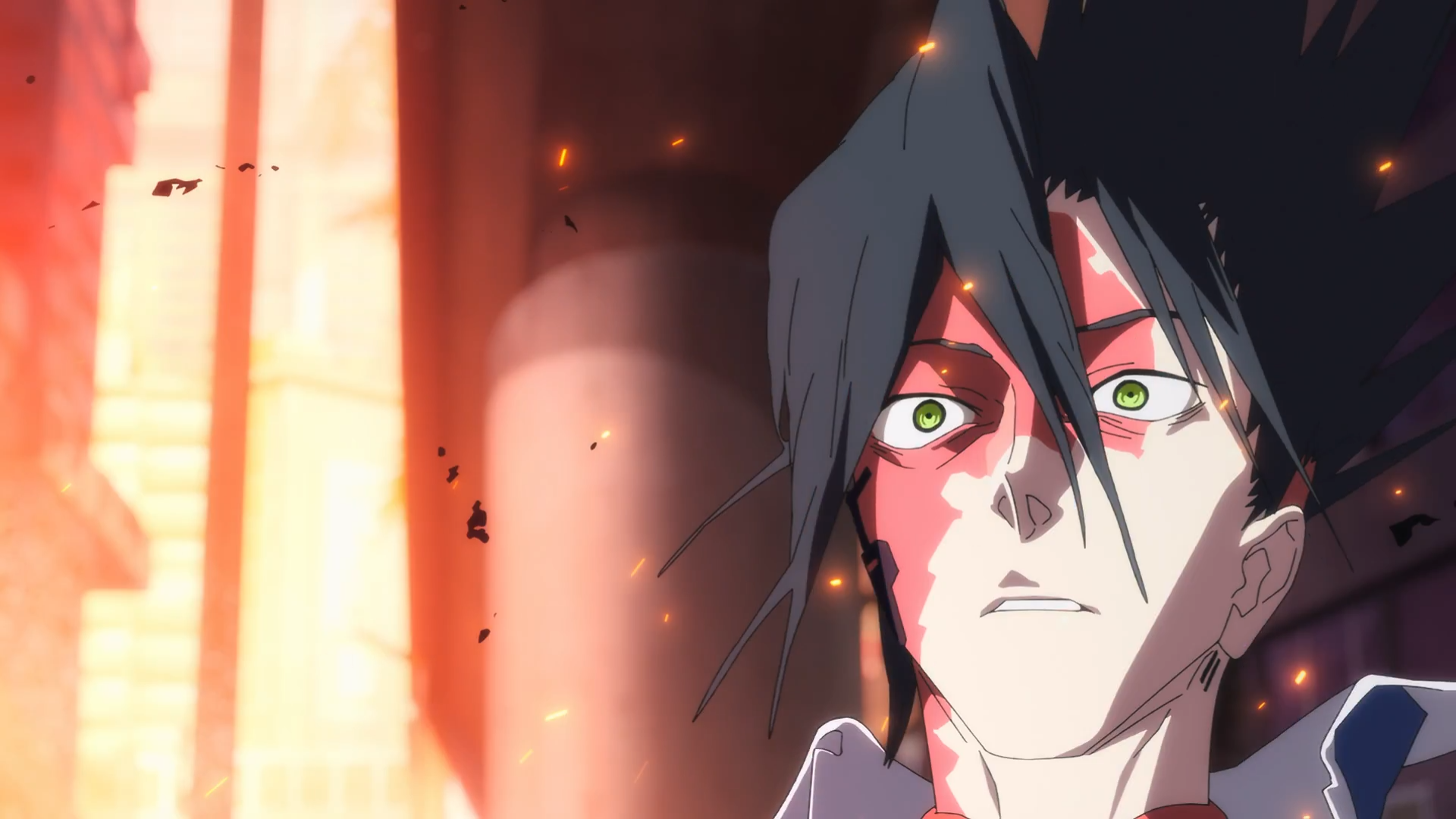
Q: What do you want people to feel when they finish CYBERPUNK: EDGERUNNERS 2?
Saya: I’ve said this before but EDGERUNNERS 1, EDGERUNNERS 2, and even Cyberpunk 2077, have one clear theme that runs through all three products and I believe that it all ties back into one of the characters from Cyberpunk 2077. I don’t know how many people here have played the game but there is a fixer called Dexter DesShawn who meets the main character and he asks a specific question which I’m going to paraphrase: “Would you rather live a normal life or would you rather go out in a blaze of glory?” That very well represents the central question of all the characters who go through the stories in the Cyberpunk franchise. If everyone could go home and please think about that, it would be great.
But please don’t go out in a blaze of glory [laughs]
Bartosz: I just want them to still feel something and I guess that if you’re saying “Okay, Season 1 broke my heart so I’m going to put it together” and I find that amazing. If you feel happy, if you feel hope—I saw the term hope a lot in this Season 2—it is awesome for me. I’d like people to just finish EDGERUNNERS 2, cry a bit, feel happy, go with their friends to the cinema, buy a ticket and watch a movie, talk for 3-4 hours with their friends about the movie that they saw. That’s why it’s super amazing that we’re having this meeting in the theater.
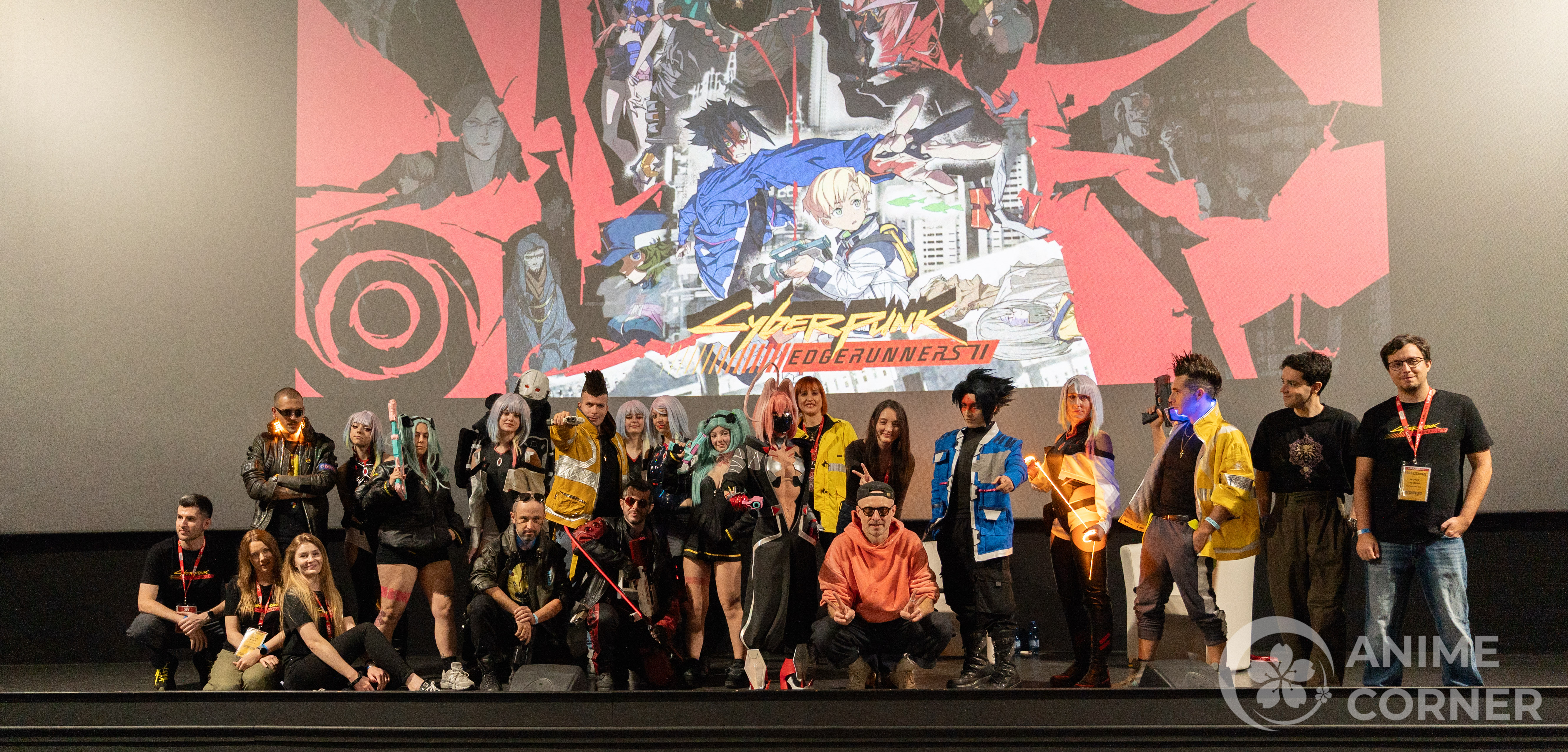
If you want to have more insights behind the ideas of Season 1, you can read our interview with Bartosz Sztybor at DoKomi. During CDPR’s visit to Lucca Comics & Games, we also had a photography session with CDPR’s official cosplayer miciaglo, who cosplayed Talia Yang from Season 2.
Stay tuned for our full article about the roundtable we took part in with Bartosz Sztybor after the panel!
About Lucca Comics & Games
Lucca Comics & Games is one of the biggest conventions in the world, taking place over five days in the historical center of the medieval Italian city of Lucca. The convention features a wide range of industries, including movies, series, video games, tabletop games, comics, anime, manga, cosplay, with their respective international guests.
The city itself is transformed for the festival, so every genre and company has a dedicated premise and whole blocks are transformed into comic hubs, tabletop zones, video game booths, and more.
Images: ©Cyberpunk: Edgerunners © 2026 CD PROJEKT S.A.

Join the discussion
Comments are linked to your Anime Corner account and published after moderation.
Sign in to comment
Use your Anime Corner Portal account across all Anime Corner services.